Introduction
When people admire a beautifully tailored suit, they usually notice the fabric, the fit, or the silhouette. Yet one of the smallest details can have a remarkable influence on the overall impression—the buttons.
Luxury suit buttons are far more than simple fasteners. They contribute to the character of the garment, complement the fabric, and reflect the level of craftsmanship behind the suit. In bespoke tailoring, choosing the right buttons is part of creating a garment that is balanced, refined, and built to last.
Whether a suit is intended for business, a wedding, or formal evening wear, the choice of button material, colour, size, and finish can subtly enhance the design.
In this guide, we'll explore how luxury suit buttons are made, the materials used by premium tailors, and why these small details matter when creating a bespoke suit.
Why Suit Buttons Matte
A button may seem insignificant compared with the fabric or cut of a jacket, but together these details shape the finished garment.
High-quality buttons help:
- Complement the suit fabric.
- Create visual balance.
- Support a timeless design.
- Enhance the perceived quality of the garment.
- Reflect attention to detail.
In bespoke tailoring, every component is selected with purpose—including the buttons.
The History of Luxury Suit Buttons
Buttons have been used on clothing for centuries, although their role has changed over time.
Originally, decorative buttons were symbols of status and craftsmanship. Wealthy individuals often wore garments featuring hand-crafted buttons made from natural materials such as horn, bone, shell, or precious metals.
As tailoring evolved, buttons became both practical and decorative. Traditional bespoke tailoring continued to value natural materials because of their durability, individuality, and elegant appearance.
Today, many luxury tailoring houses still choose premium natural buttons for their distinctive texture and refined finish.
What Makes a Button "Luxury"?
Not every button is created equally.
Luxury buttons are typically distinguished by:
- Carefully selected materials.
- Consistent shape and thickness.
- Smooth finishing.
- Rich natural texture.
- Durability suitable for long-term wear.
Rather than focusing on decoration alone, premium buttons are chosen to complement the style and purpose of the suit.
1. Genuine Horn Buttons
Horn buttons are among the most recognised choices in bespoke tailoring.
They are produced from natural horn, giving each button its own unique pattern and colour variation.
2. Mother-of-Pearl Buttons
Mother-of-pearl buttons are created from the inner layer of certain shells.
They are admired for their natural lustre and refined appearance.
Advantages
- Elegant shine.
- Smooth surface.
- Lightweight.
- Popular for luxury dress shirts.
- Suitable for formal tailoring.
Because of their sophisticated finish, mother-of-pearl buttons are often selected for premium shirts and formal garments.
3. Corozo Buttons
Corozo buttons are crafted from the seeds of the tagua palm, sometimes referred to as "vegetable ivory."
They are valued for their natural appearance and ability to absorb dye evenly.
Advantages
- Plant-based material.
- Durable.
- Rich colour consistency.
- Smooth finish.
- Available in a wide range of colours.
Corozo buttons are a popular option for bespoke jackets and sports coats.
4. Metal Buttons
Metal buttons are commonly associated with blazers and ceremonial jackets.
Materials may include brass or other durable alloys with polished or matte finishes.
Advantages
- Strong construction.
- Distinctive appearance.
- Ideal for navy blazers.
- Timeless style.
Gold and silver-toned metal buttons are especially popular on classic club blazers.
5. Wood Buttons
Wood buttons provide a warm, natural character.
They are frequently used on casual tailoring, linen jackets, and safari-style garments.
Advantages
- Natural texture.
- Lightweight.
- Relaxed appearance.
- Complements linen and cotton fabrics.
Wood buttons are generally chosen for informal rather than business tailoring.
6. Premium Resin Buttons
Modern resin buttons can be manufactured to a high standard, offering consistency and durability.
Quality resin buttons are often designed to resemble natural materials while providing reliable performance.
They are commonly used when a specific colour or finish is required.
How Tailors Choose the Right Buttons
Selecting buttons is not simply about personal preference.
Experienced tailors consider several factors
Dark navy suits often pair well with dark horn buttons, while lighter jackets may benefit from contrasting tones.
Fabric Texture
The button should complement the character of the fabric rather than compete with it.
For example:
- Smooth worsted wool often suits polished horn.
- Textured tweed may pair well with matte horn or wood.
Occasion
Business suits generally favour understated buttons.
Wedding jackets may allow for more distinctive finishes.
Casual tailoring offers greater flexibility in material and colour.
Personal Style
Some clients prefer traditional elegance, while others enjoy subtle modern details.
A bespoke tailor helps match these preferences with suitable button options.
Why Natural Materials Are Popular
Many luxury tailoring houses continue to favour natural materials because each button is unique.
Unlike mass-produced synthetic buttons, natural materials often display slight variations in colour and grain, adding individuality to the finished garment.
These characteristics contribute to the appeal of bespoke tailoring, where every detail is chosen with care.
How Genuine Horn Suit Buttons Are Made
Genuine horn buttons are among the most respected choices in bespoke tailoring because every button has a unique natural pattern. No two horn buttons are exactly alike, making them a favourite for luxury suits.
The manufacturing process combines traditional craftsmanship with modern precision.
Step 1: Selecting the Raw Material
The process begins with carefully selected natural horn. Only high-quality sections with the right thickness, colour, and strength are chosen for button production.
Each piece is inspected to ensure it is suitable for tailoring.
Step 2: Cutting the Button Blanks
The horn is cut into small circular discs, often called button blanks.
At this stage, the buttons still have rough edges and require further shaping.
Precision is essential because every button must be consistent in size and thickness.
Step 3: Shaping the Buttons
Special machinery or skilled craftsmen shape each blank into its final form.
The edges are rounded to create a smooth finish that feels comfortable and looks refined.
Luxury tailoring places great importance on this stage because the shape affects both appearance and durability.
Step 4: Drilling the Holes
Each button is drilled with carefully positioned holes.
Accurate spacing ensures the button sits correctly on the jacket and can be securely sewn onto the garment.
Step 5: Polishing
After shaping, the buttons are polished to reveal the natural beauty of the horn.
Depending on the design, the finish may be:
- Matte
- Satin
- Semi-gloss
- High polish
Different finishes suit different styles of tailoring.
How Mother-of-Pearl Buttons Are Made
Mother-of-pearl buttons are admired for their elegant natural shine.
They are commonly used on luxury dress shirts and formal garments.
Step 1: Selecting the Shell
Only shells with attractive colour, thickness, and quality are chosen.
Natural variations make every button slightly different.
Step 2: Cutting
Circular discs are cut from the shell with precision equipment.
The process requires care because shell material is naturally delicate.
Step 3: Grinding and Smoothing
Each button is ground until it reaches the desired thickness.
The edges are then smoothed to create a comfortable finish.
Step 4: Drilling and Polishing
The button holes are drilled before the surface is polished to highlight the shell's natural lustre.
The finished product reflects light beautifully, giving luxury shirts their sophisticated appearance.
How Corozo Buttons Are Made
Corozo is often called vegetable ivory because of its smooth texture and excellent durability.
It comes from the seed of the tagua palm.
Harvesting
The mature seeds are collected and dried naturally.
Drying hardens the material and prepares it for manufacturing.
Cutting
The seeds are sliced into button-sized discs.
Their natural density makes them suitable for long-lasting buttons.
Dyeing
One advantage of Corozo is that it absorbs colour evenly.
Manufacturers can produce buttons in a wide range of colours while maintaining a natural appearance.
Finishing
The buttons are polished and inspected before being prepared for tailoring.
Because Corozo is both durable and attractive, it is widely used in premium jackets and sports coats.
Quality Control in Luxury Button Manufacturing
Luxury tailoring is built on consistency and attention to detail.
Before buttons are approved, manufacturers carefully inspect them for:
- Size consistency
- Colour variation
- Surface finish
- Hole alignment
- Thickness
- Edge smoothness
- Structural strength
Only buttons that meet strict quality standards are selected for premium garments.
Why Luxury Tailors Carefully Match Buttons to Fabrics
Buttons are never chosen in isolation.
Experienced tailors consider how every component works together.
For example:
Navy Business Suit
Recommended buttons:
- Dark horn
- Matte horn
- Deep brown Corozo
These options create a professional, understated appearance.
Charcoal Suit
Suitable choices include:
- Black horn
- Dark grey horn
- Matte Corozo
These colours maintain a clean and timeless look.
Linen Suit
Natural materials often complement linen particularly well.
Popular options include:
- Light horn
- Wood
- Beige Corozo
These choices reflect the relaxed character of linen tailoring.
Blazer
Classic navy blazers are often paired with polished metal buttons in gold or silver tones, depending on the overall design.
Why Button Colour Matters
The colour of a button can subtly influence the appearance of the entire suit.
A well-chosen button can:
- Complement the fabric.
- Create visual balance.
- Highlight craftsmanship.
- Maintain a timeless style.
Rather than drawing attention to itself, the button should support the overall design.
Common Myths About Luxury Suit Buttons
Myth 1: All Black Buttons Are the Same
False.
Buttons that appear similar from a distance may differ greatly in material, texture, finish, and durability.
Natural horn, Corozo, and quality resin each have distinct characteristics.
Myth 2: Expensive Buttons Automatically Make a Better Suit
Not necessarily.
The quality of a suit depends on many elements, including fabric, construction, fit, pattern cutting, and craftsmanship.
Buttons are one important detail, but they work best as part of a well-balanced garment.
Myth 3: Natural Buttons Require Excessive Maintenance
Generally, no.
With normal care and proper storage, quality buttons remain attractive for many years.
Like the suit itself, they simply benefit from sensible handling and maintenance.
How Buttons Are Sewn Onto a Bespoke Suit
Choosing a luxury button is only part of the process. The way it is attached to the jacket is equally important.
In bespoke tailoring, buttons are sewn with precision to ensure they are secure, functional, and complement the overall design.
Experienced tailors pay close attention to:
- Correct thread tension.
- Consistent spacing.
- Button alignment.
- Thread colour.
- Long-term durability.
These small details contribute to a suit that performs well through years of regular wear.
Hand-Sewn vs Machine-Sewn Buttons
Both methods have their place in tailoring, but they serve different purposes.
Hand-Sewn Buttons
Many bespoke garments use hand-sewn buttons because they allow greater control over placement and finishing.
Advantages include:
- Precise positioning.
- Strong attachment.
- Traditional craftsmanship.
- Easy future repairs if required.
Machine-Sewn Buttons
Machine sewing is widely used in large-scale garment production.
It offers:
- Speed.
- Consistency.
- Efficient manufacturing.
While machine sewing is practical for mass production, bespoke tailoring often incorporates hand finishing to achieve a more personalised result.
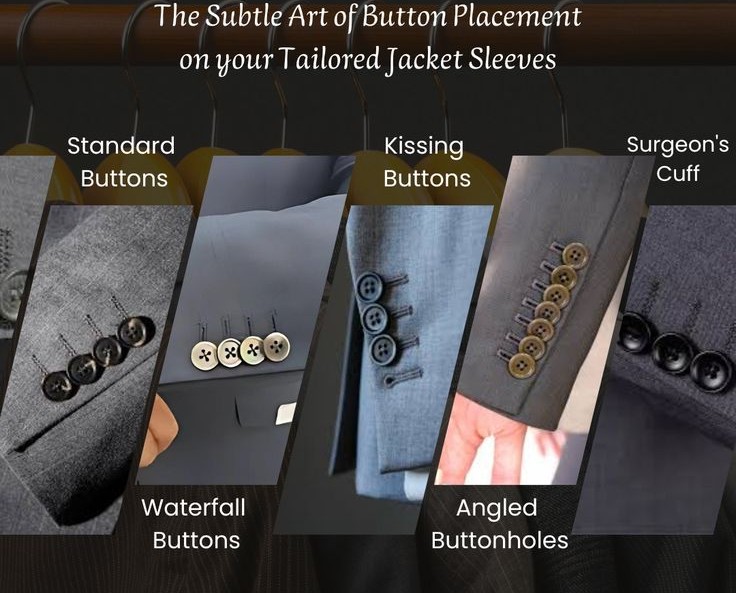
What Are Functional Surgeon's Cuffs?
One hallmark of many bespoke jackets is the functional surgeon's cuff.
Unlike decorative sleeve buttons found on many ready-made suits, functional cuffs allow the sleeve buttons to be opened and closed.
Historically, this feature is associated with traditional tailoring and remains a popular bespoke option today.
Many clients choose functional cuffs because they reflect classic craftsmanship and allow for additional personalisation.
Choosing the Right Buttons for Different Suit Styles
The ideal button depends on the fabric, colour, and purpose of the suit.
Business Suit
Recommended choices:
- Dark horn.
- Matte Corozo.
- Understated finishes.
These combinations create a professional and timeless appearance.
Wedding Suit
Depending on the style, suitable options may include:
- Polished horn.
- Mother-of-pearl (often for shirts rather than jackets).
- Elegant metal buttons for selected formal garments.
The goal is to complement the overall outfit rather than dominate it.
Linen Jacket
Natural materials often work particularly well with linen.
Popular options include:
- Light horn.
- Wood.
- Beige or tan Corozo.
These choices reinforce the relaxed character of summer tailoring.
Blazer
Classic navy blazers are traditionally paired with metal buttons in polished or brushed finishes.
This creates a distinctive look that has remained popular for generations.
How to Care for Luxury Suit Buttons
Quality buttons require very little maintenance, but a few simple habits can help preserve their appearance.
Keep Buttons Clean
Use a soft cloth to remove dust and fingerprints after occasional wear.
Store Your Suit Properly
Hang the jacket on a broad wooden hanger to reduce unnecessary pressure on the buttons.
Avoid Harsh Chemicals
Strong cleaning products may affect the finish of some natural materials.
Professional garment care is generally the safest approach.
Check Loose Buttons
Inspect buttons periodically.
If one becomes loose, have it reattached before it falls off and is lost.
Why Small Details Define Luxury Tailoring
Luxury tailoring is rarely about one feature alone.
Instead, it is the combination of carefully chosen elements that creates a refined garment.
These include:
- Premium fabric.
- Balanced pattern cutting.
- Skilled construction.
- Careful finishing.
- Quality lining.
- Well-matched buttons.
- Thoughtful proportions.
When these details work together, the result is a suit that feels cohesive and elegant.
Frequently Asked Questions
1. What are the best buttons for a luxury suit?
Genuine horn, Corozo, and quality metal buttons are among the most popular choices for bespoke tailoring. The best option depends on the fabric, colour, and intended use of the suit.
2. Are horn buttons better than plastic buttons?
Natural horn offers a distinctive appearance and unique grain patterns that many people appreciate. High-quality synthetic buttons can also perform well, but natural materials remain a traditional choice in bespoke tailoring.
3. Why do bespoke suits use premium buttons?
Premium buttons are selected to complement the overall design, provide durability, and reflect the attention to detail associated with bespoke craftsmanship.
4. Can I customise the buttons on my bespoke suit?
Yes. One of the advantages of bespoke tailoring is the ability to choose details such as button material, colour, finish, size, and style to suit your preferences.
5. How long do quality suit buttons last?
With normal wear and proper care, well-made buttons can remain in excellent condition for many years. If a button becomes loose, it is usually straightforward for a tailor to secure it again.
Why Choose Kim Bespoke BKK?
At Kim Bespoke BKK, we believe exceptional tailoring is built on thoughtful craftsmanship from the inside out.
Every bespoke garment is designed around your individual measurements, preferences, and lifestyle. From premium fabrics to carefully selected buttons and finishing details, each element is chosen to create a suit that combines comfort, durability, and timeless style.
We offer:
- Bespoke business suits.
- Wedding suits and tuxedos.
- Custom shirts.
- Women's tailoring.
- Premium fabrics from Dormeuil, Drago, Zegna, and other renowned mills.
- Worldwide shipping.
- Online consultations.
- Secure measurement storage for up to 5 years for convenient repeat orders.
Whether you're visiting Bangkok or ordering internationally, our goal is to deliver a personalised tailoring experience with lasting value.
Final Thoughts
Luxury tailoring is defined by the details.
While buttons may be among the smallest components of a suit, they contribute to its character, balance, and craftsmanship. Choosing the right material, finish, and style helps create a garment that looks refined and performs well over time.
Understanding how luxury suit buttons are made also offers a deeper appreciation for the care and expertise involved in bespoke tailoring. From the selection of natural materials to the final hand-sewn attachment, each step reflects a commitment to quality.
A well-crafted suit is not simply assembled—it is thoughtfully created, one detail at a time.