The Anatomy of a Perfect Suit: What Happens Between Your First Measurement and the Final Stitch?
What Actually Happens When You Order a Bespoke Suit?
Most people see the finished suit.
They see the fabric.
They notice the lapels.
They see the buttons, pockets, stitching and silhouette.
But they don't see everything that happens before the suit reaches their wardrobe.
A truly bespoke suit begins long before the first piece of fabric is cut.
It begins with a conversation.
Then come measurements, proportions, fabric selection, design decisions, pattern development, cutting, construction, fittings, adjustments and finishing.
Every stage contributes to the final garment.
And while a suit may appear simple from the outside, there is an entire process hidden inside it.
At Kim Bespoke BKK, we believe understanding that process helps customers appreciate what makes a genuinely personalized suit different from an ordinary off-the-rack garment.
The Anatomy of a Perfect Suit
A suit is not one object.
It is a combination of many interconnected elements.
Think of it as an architecture built around the human body.
The shoulders create the frame.
The chest creates volume.
The waist creates shape.
The lapels establish visual direction.
The sleeves connect the jacket to the arms.
The trousers complete the lower silhouette.
The fabric gives the garment its character.
And the stitching holds everything together.
If one element is poorly balanced, the entire garment can look different.
That is why bespoke tailoring is about much more than taking measurements.
Step 1: The First Consultation
Before a measuring tape is used, there should be a conversation.
What is the suit for?
A business suit?
A wedding?
A formal event?
Travel?
Everyday professional wear?
A special occasion?
The answer affects many decisions later.
A wedding suit may have a different design philosophy from a business suit.
A suit designed for frequent travel may prioritize comfort and versatility.
A formal evening garment may require a different level of structure and detailing.
The consultation is therefore where the tailor begins to understand the person behind the measurements.
Step 2: Understanding Your Personal Style
Bespoke does not mean that the tailor simply decides everything for you.
The customer should have a voice in the process.
You may prefer:
- Classic or modern styling
- Single-breasted or double-breasted
- Notch or peak lapels
- Slim or relaxed trousers
- Traditional or contemporary proportions
- Minimal or distinctive details
A good tailor helps translate those preferences into a garment that works with your body.
The goal isn't to follow every fashion trend.
The goal is to create something that feels appropriate for you.
Step 3: Choosing the Right Fabric
Fabric selection is one of the most enjoyable parts of ordering a bespoke suit.
But it is also one of the most important.
Two fabrics can have the same color but behave completely differently.
The tailor may consider:
- Weight
- Texture
- Breathability
- Drape
- Durability
- Pattern
- Season
- Intended use
- Climate
For Bangkok customers, climate deserves particular attention.
A beautiful fabric is not necessarily the right fabric if it makes the wearer uncomfortable in warm and humid conditions.
The right choice should balance appearance, performance and comfort.
At Kim Bespoke BKK, clients can explore a range of luxury and premium fabric options, including fabrics from internationally recognized mills.
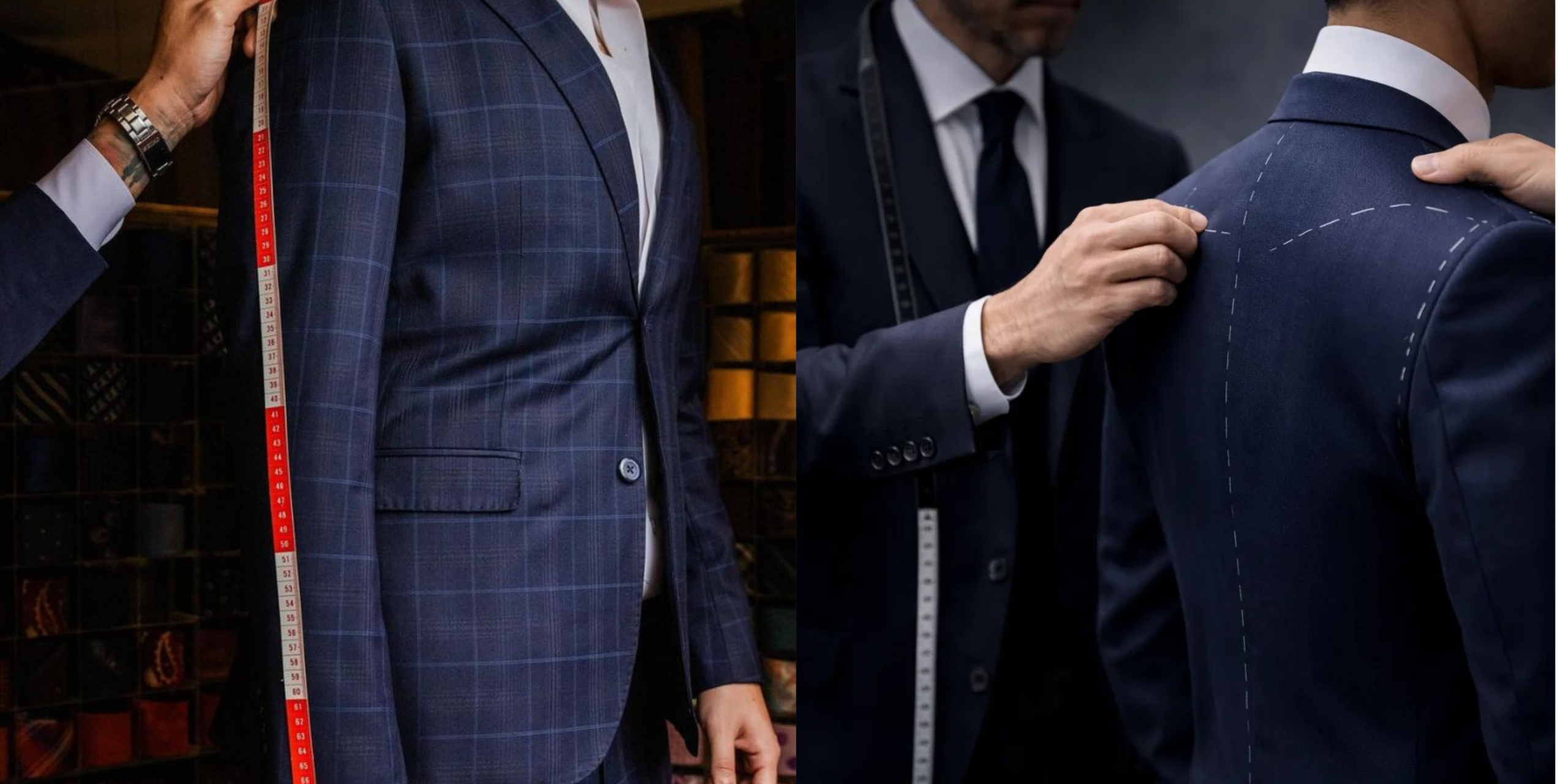
Step 4: Taking Your Measurements
This is where the bespoke process becomes truly personal.
A tailor may measure much more than chest, waist and sleeve length.
Measurements can include areas such as:
- Chest
- Waist
- Hips
- Shoulder width
- Arm length
- Jacket length
- Back length
- Trouser waist
- Trouser rise
- Inseam
- Thigh
- Knee
- Trouser opening
But measurements alone don't tell the whole story.
The tailor also needs to observe how the body is shaped and how it stands.
Step 5: Understanding Your Posture
Two people can have very similar measurements and still require different adjustments.
Why?
Because people stand differently.
One person may naturally carry the shoulders forward.
Another may have a straighter posture.
One shoulder may sit slightly higher than the other.
The back may have a particular shape.
The head position can differ.
These characteristics affect how a jacket sits.
This is why bespoke tailoring is not simply about entering measurements into a size chart.
The tailor is creating a garment around a three-dimensional human body.
Step 6: Creating the Pattern
The measurements and design decisions now need to become a pattern.
The pattern acts as the blueprint for the garment.
It determines how different pieces of fabric will eventually come together.
This stage requires precision because small changes can influence the final proportions.
The pattern needs to account for the intended silhouette, body measurements and construction.
This is where the invisible work begins to become a physical garment.
Step 7: Laying and Cutting the Fabric
Once the pattern is ready, the fabric can be prepared for cutting.
This stage requires care.
A tailor must consider the direction and characteristics of the fabric.
If the fabric contains a stripe, check, or other pattern, matching it correctly can be particularly important.
The cutting stage is one of those moments where there is very little room for careless work.
Once the cloth is cut, the pieces become the foundation of the finished suit.
Step 8: Building the Jacket
Now the separate pieces begin to become a jacket.
The chest, front panels, back, sleeves, collar and other components are progressively assembled.
The construction method matters.
Depending on the garment, different construction techniques can influence:
- Structure
- Drape
- Comfort
- Longevity
- Flexibility
- Overall appearance
This is also where the character of the fabric begins to emerge.
A beautiful piece of cloth is only the starting point.
How it is constructed determines how it behaves as clothing.
Step 9: Constructing the Shoulders
The shoulder is one of the most important structural areas of a suit.
It creates the beginning of the jacket's silhouette.
Too much structure can make the wearer appear overly broad.
Too little structure may create a softer appearance.
The correct approach depends on the individual's proportions and desired style.
The objective is not simply to create larger shoulders.
It is to create balance.
A well-proportioned shoulder can make the entire jacket look more refined.
Step 10: Shaping the Chest and Waist
The jacket needs to follow the body without restricting movement.
This requires careful balance.
The chest needs enough room.
The waist can be shaped to create a clean silhouette.
But excessive suppression can create tension and pulling.
Too little shaping can make the jacket appear boxy.
The correct amount depends on the wearer.
This is another reason there is no single “perfect” suit shape for everyone.
Step 11: The First Fitting
This is one of the most important moments in the bespoke process.
The first fitting allows the tailor to evaluate how the developing garment interacts with the actual body.
The tailor can examine:
- Shoulder position
- Chest balance
- Jacket length
- Waist shape
- Collar position
- Sleeve length
- Overall proportions
- Movement
This is where theory meets reality.
A measurement may look correct on paper, but the fitting reveals how everything works together.
Step 12: Walking, Moving and Sitting
A suit isn't designed only for standing still.
During a fitting, movement matters.
Walk.
Sit.
Move your arms.
Turn.
Raise your arms naturally.
The tailor needs to see how the garment behaves.
A suit should not only look good when you are standing in front of a mirror.
It should work when you are actually wearing it.
This is particularly important for customers who will spend long days in their suits.
Step 13: Making the Adjustments
After the fitting, adjustments may be required.
Perhaps the sleeve needs refinement.
Maybe the jacket length needs changing.
Perhaps the waist needs a little more or less shaping.
Maybe the shoulder balance needs attention.
These adjustments are part of the process.
They are not necessarily evidence that something went wrong.
They are how the garment becomes progressively more personalized.
Step 14: The Details Begin to Matter
Once the major proportions are correct, the smaller details become increasingly important.
These can include:
- Lapel width
- Lapel shape
- Button position
- Pocket placement
- Pocket style
- Sleeve buttons
- Trouser waistband
- Belt loops or side adjusters
- Cuff style
- Stitching details
These details should work together.
A suit should not feel like a collection of unrelated design choices.
Everything should contribute to one coherent look.
Step 15: The Second Fitting
Depending on the garment and tailoring process, another fitting may be used to evaluate the latest adjustments.
The goal is refinement.
The tailor checks whether previous changes have improved:
- Balance
- Comfort
- Silhouette
- Movement
- Proportion
This is where the suit begins to look increasingly like the finished garment.
Step 16: The Final Stitch
Eventually, the individual components become one complete suit.
The jacket is finished.
The trousers are completed.
Buttons and finishing details are added.
Edges are refined.
The garment is pressed and prepared.
But the final stitch isn't simply the end of sewing.
It represents the completion of hundreds of decisions made throughout the process.
From the first conversation to the final fitting, every decision has contributed to the finished garment.
Step 17: The Final Inspection
Before a bespoke suit is handed to its owner, it deserves a final inspection.
The tailor can examine:
- Stitching
- Buttons
- Lapels
- Collar
- Sleeves
- Pockets
- Trousers
- Overall symmetry
- Pressing
- General finishing
The final garment should feel complete.
Not simply finished.
Complete.
Why the First Measurement Is So Important
It is easy to think that the measuring tape is simply recording numbers.
But measurements become the foundation of the entire process.
If the starting information is inaccurate, later stages can become more difficult.
This is why careful measuring matters.
The tailor needs to understand not only:
“What are your measurements?”
but also:
“How does your body move?”
That distinction is one of the foundations of thoughtful bespoke tailoring.
Why Bespoke Suits Take Time
A bespoke suit isn't produced by selecting a standard size and making a few minor changes.
The garment goes through multiple stages.
Consultation → Measurement → Design → Fabric → Pattern → Cutting → Construction → Fitting → Adjustments → Finishing
Each stage requires attention.
The exact timeline can vary depending on the tailor, construction, fabric, number of fittings and level of customization.
But the principle remains the same:
A personalized garment requires a personalized process.
Off-the-Rack vs Custom vs Bespoke
It is useful to understand the difference.
Off-the-Rack
Designed around standardized sizes.
The customer chooses the closest available size.
Made-to-Measure / Custom
A standard pattern is generally adjusted using the customer's measurements.
Bespoke
The garment is developed around the individual with a much greater focus on personal measurements, proportions, posture and design.
The terminology and exact processes can vary between tailors, so customers should always ask what a particular tailor means by “custom” or “bespoke.”
Why Fabric Alone Doesn't Make a Great Suit
A famous fabric label can be attractive.
But fabric is only one component.
You can have exceptional cloth and still have a poorly balanced suit.
The final result depends on the relationship between:
Fabric + Pattern + Construction + Fit + Finishing
A great suit brings all five together.
The Invisible Work Behind a Bespoke Suit
Some of the most important work is invisible.
Customers may never see:
The pattern adjustments.
The internal construction.
The small corrections made during fittings.
The careful alignment of components.
The finishing work.
The decisions made based on posture.
Yet these invisible details can influence how the finished suit looks and feels.
That is the fascinating part of bespoke tailoring.
The quality is often found in details that most people cannot immediately identify.
Why Bangkok Requires Thoughtful Suit Selection
Bangkok's warm climate makes comfort an important part of tailoring.
A suit intended for Bangkok may need different fabric and construction considerations from one intended for a colder climate.
Breathability, weight, layering and intended use should all be discussed during the consultation.
This is particularly important for clients visiting Bangkok for business, weddings or special events.
A suit should look sophisticated without ignoring the environment in which it will be worn.
What Makes a Perfect Suit?
There is no single universal definition of a perfect suit.
A perfect suit for one person may not be perfect for another.
The right suit should consider:
Fit
Does it follow the body correctly?
Proportion
Does the silhouette look balanced?
Comfort
Can you move naturally?
Fabric
Is the material appropriate for the intended use and climate?
Construction
Does the garment have the structure and behavior you want?
Purpose
Does it work for the occasion?
When these elements come together, the suit becomes more than clothing.
It becomes personal.
The Kim Bespoke BKK Approach
At Kim Bespoke BKK, we believe the bespoke experience should begin with understanding the customer.
Whether you need a business suit, wedding suit, tuxedo, linen suit or another custom garment, the process should be built around your requirements.
From the initial consultation and measurements to fabric selection, fitting and final finishing, every stage contributes to the finished result.
Our objective is simple:
To create a suit that is made for you—not simply adjusted for you.
The Final Stitch Is Only the Beginning
When you finally put on your completed bespoke suit, it can be tempting to think:
“This is the finished product.”
But the suit is really the result of everything that happened before it.
Your first conversation.
Your measurements.
Your posture.
Your fabric choice.
Your pattern.
The cutting.
The construction.
The fittings.
The adjustments.
The finishing.
The final stitch.
That's what makes bespoke tailoring different.
A suit may look simple when you see it hanging in a wardrobe.
But behind that simplicity is a process involving precision, craftsmanship and countless small decisions.
And that is the true anatomy of a perfect suit.
Frequently Asked
What is the bespoke tailoring process?
The bespoke tailoring process generally involves consultation, measurements, design decisions, fabric selection, pattern development, cutting, construction, fittings, adjustments and final finishing. Exact processes vary between tailors.
How does a bespoke suit differ from an off-the-rack suit?
An off-the-rack suit is produced using standardized sizes. Bespoke tailoring focuses much more extensively on the individual customer's measurements, proportions, posture, preferences and desired design.
How many fittings does a bespoke suit require?
The number of fittings varies depending on the tailor, construction method, garment and customer's requirements. Some bespoke processes involve multiple fittings to refine the garment.ction, fitting schedule and level of customization. It is best to confirm the expected timeline during the initial consultation.
What measurements are needed for a bespoke suit?
Measurements can include the chest, waist, hips, shoulders, arms, jacket length, trouser waist, rise, inseam, thigh and other dimensions. A tailor may also assess posture and proportions.
What fabric is best for a bespoke suit in Bangkok?
There isn't one fabric that is best for everyone. Fabric selection should consider the intended use, weight, breathability, durability, appearance and Bangkok's warm climate.
Is a bespoke suit worth it?
For customers who value personalized fit, design, fabric selection and craftsmanship, bespoke tailoring can provide a more individualized experience than standardized clothing. The value depends on the customer's needs and priorities.